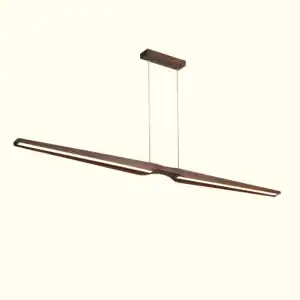
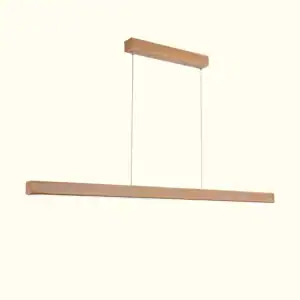
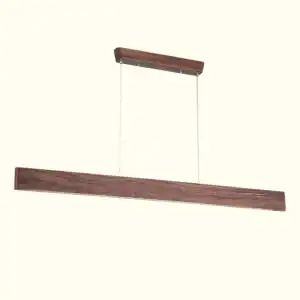
Almost every customer who comes to look at our wooden lights asks the same first question:
“Is this solid wood, or engineered wood?”
I know what they’re really wondering:
- Am I paying solid-wood prices for something that’s just veneer?
- Will this start to look tired—peel, crack, or age badly in a few years?
- Is the price actually justified?
- Am I being asked to pay for a difference I can’t even see?
Solid wood and engineered wood are fundamentally different in structure and density.
Because of that, they respond differently to light, pressure, and time.
What the Material Really Is
Solid Wood
Solid wood means wood cut directly from a single piece of natural timber—such as oak, walnut, ash, or beech.
Every piece of solid wood carries:
Its own natural grain pattern
Subtle variations in color
Traces of how the tree grew
Grain with depth and direction
This means no two solid-wood lamps are ever exactly the same—even if they come from the same log.
Over time, solid wood doesn’t stay rigid or static.
It warms.
The grain softens.
The color shifts slightly.
It changes—quietly and naturally.

Engineered Wood
Engineered wood is designed to be predictable.
It’s made from compressed wood fibers (like MDF), or from thin layers of wood bonded together with adhesives (such as plywood or veneer).
Its strengths are clear:
Consistent grain appearance
Dimensional stability
Easier large-scale production
If you want pieces to match perfectly, or you prefer a clean, uniform look, engineered wood does its job well.
What You Feel When You Touch It
Solid wood feels warm to the hand. The grain has resistance, texture, and depth.
It also has weight—you feel its density.
Engineered wood feels smoother and more uniform.
It’s generally lighter.
Both are good materials. But they don’t feel the same—and that difference matters more than people realize.
The Difference You Can Hear
When you tap on solid wood, the sound is low, muted, and full.
When you drive a screw into it, you feel resistance.
There’s feedback during the process—you know how the material is responding.
Engineered wood sounds different.
The knock is lighter, slightly hollow, sometimes sharper.
Screws go in faster, with less resistance and less grip.
Edges and Details
Solid wood:
- Allows for natural chamfers and rounded edges
- Has layered, dimensional edges
- Even after wear, light sanding reveals… more wood
Engineered wood:
- Requires edge banding
- Chips or impacts can expose the inner structure
- Repairs are difficult—and sometimes impossible without replacement
How They Age
Solid wood develops patina.
The color deepens;
The surface becomes softer;
It looks used—but cared for.
Engineered wood shows wear.
Scratches are more obvious;
Surface damage is often irreversible.
Why the Price Is Different
Solid wood lighting usually costs more—and not just because of the material itself.
It involves:
- Careful material selection and rejection
- Moisture and humidity control
- Slower machining
- More hands-on craftsmanship
- Lower production volume
You’re not paying for a piece of wood. You’re paying for the ability to turn that wood into a stable, long-lasting light.
A Note on Sustainability
Solid-wood lamps often use:
- Natural timber
- Low-VOC oils or wax finishes, such as hardwax oils or plant-based coatings
- Simple, repairable structures
- They’re closer to furniture-grade pieces made for long-term use.
Engineered wood can be sustainable—but quality matters.
- Adhesives
- Emission standards
- Manufacturing control
High-quality engineered wood can be safe. But as consumers, it’s often hard to tell whether a product uses particle board or higher-grade plywood.
Which One Is Right for You?
Solid wood lighting may suit you if you:
- Love natural materials
- Accept small variations
- Want a lamp that ages along with your space
Engineered wood lighting may be a better fit if you:
- Prefer visual consistency
- Are budget-conscious
- Care more about form than material
In the end, there’s no universal better. There’s only the choice that fits how you live.